


Forgiving Your Past Self Regret: A Guide to Releasing the Weight of "Should-Haves"
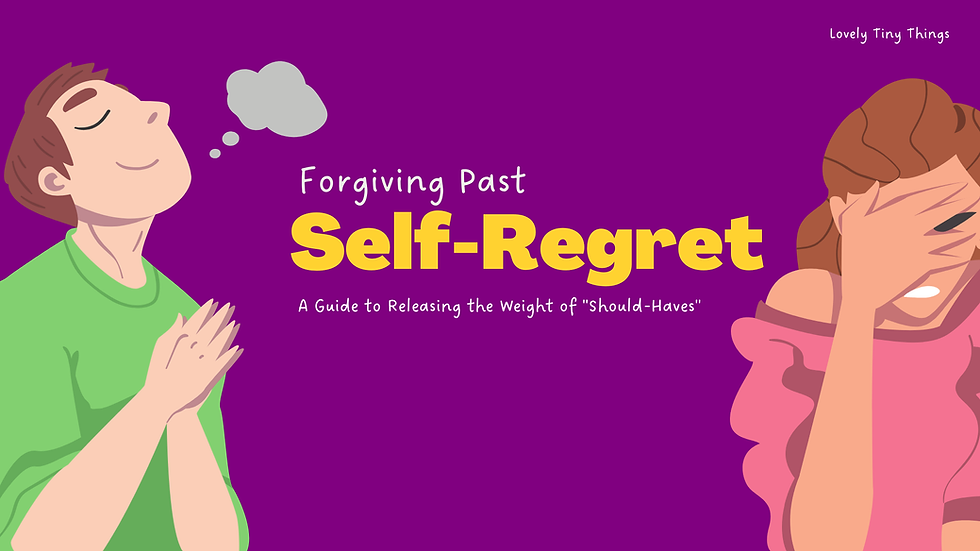
A Note from Samidha Mathur: I am not a therapist or a life coach. I am someone who spent years anchored to the past, replaying old mistakes like a movie that never ends. I’ve realized that we often treat ourselves with a harshness we would never show to a stranger. This post on forgiving your past self is your "First-Aid Kit" for self-forgiveness. It’s about putting down the heavy baggage of regret so you can finally walk freely in the present.
The Heavy Burden of "Should-Have"
We all have a version of ourselves that lives in the past. She is the woman who made that "wrong" career choice, the one who stayed too long in a toxic relationship, or the one who didn't speak up when her boundaries were crossed. We look back at her from the safety of the present and judge her with a cold, unforgiving eye. We tell ourselves:
"I should have known he wasn't right for me."
"I should have been stronger during that family crisis."
"I should have saved more money or taken that risk."
This "Weight of Should-Haves" is a special kind of mental tax. It’s a silent thief that steals your energy today to pay for a "debt" that occurred years ago. But here is the logical flaw: you are judging your past self using the wisdom, strength, and perspective you only gained because of those very experiences. It is unfair to punish the version of you from five years ago for not knowing what you know today. You are effectively punishing a student for failing a test they hadn't even been given the textbook for yet.
Why We Get Stuck in the "Rearview Mirror"?
Why is letting go so incredibly difficult? For many of us—especially within a culture that prizes "duty," "perfection," and "family reputation"—regret feels like a form of penance. We subconsciously believe that if we feel bad enough for long enough, we can somehow "undo" the past or prove that we are "good people" who care about our mistakes.
However, regret is a circular road; it feels like movement, but it takes you nowhere. Scientifically speaking, when you dwell on regret, your brain stays in a state of high stress (cortisol). You are telling your nervous system that you are still in danger from a mistake that is actually over and done. To move into Healing Beyond Therapy, and forgiving your past self, we have to realize that holding onto guilt doesn't change the past—it only ruins the "lovely tiny things" waiting for you in the present. You cannot build a beautiful future if both your hands are busy clutching the wreckage of yesterday.
The "Survival Mode" Truth: You Did Your Best to Forgive Your Past Self
One of the most important steps in forgiving your past self is understanding the why behind your past actions. Most of the things we regret were not acts of malice or stupidity; they were survival decisions.
Think back to your "past self" during that time you regret. Be honest with her:
Was she exhausted?
Was she lonely or scared of being alone?
Was she trying to keep the peace in a household where she felt unheard?
Did she have the mental health tools she has now?
In those moments, you weren't trying to fail. You were doing the absolute best you could with the tools, emotional energy, and information you had at that exact second. Your past self was in "Survival Mode," trying to protect you the only way she knew how. The fact that you can now look back and see a better way is not a reason to shame her—it is proof of how much you have grown. You don't need to punish her for surviving.
The Leakage: How Past Regret Poisons Your Present
The real danger of not forgiving yourself isn't just that you feel "sad" about the past; it's that the past starts to "leak" into your current life. For an Indian woman juggling a career and a home, this leakage usually shows up in three ways:
The "Second-Guessing" Virus: Because you regret a past choice (like a failed investment or a career move), you no longer trust yourself to make decisions today. You over-analyze every small email or household choice because you are afraid of "failing again."
The "Joy-Blocker": When a "lovely tiny thing" happens—like a promotion or a beautiful family dinner—a voice in your head says, "You don't deserve this because of what you did back then." You rob yourself of the present moment to satisfy a ghost.
Physical Exhaustion: Carrying the weight of "should-haves" is physically draining. Your brain is stuck in a loop, wasting the "battery" you need for your current responsibilities. You aren't just mentally tired; you are soul-tired.
To move into Healing Beyond Therapy, we have to realize that holding onto guilt doesn't change the past—it only ruins the "lovely tiny things" waiting for you right now.
The Flow: When Your "Yesterday" Steals Your "Today"
I remember a period where I was finally in a "good place." I had a stable job, my health was improving, and my home was peaceful. On paper, I should have been happy. But I wasn't.
Every time I sat down to enjoy a quiet cup of chai, my mind would drift back to a mistake I made in my early 20s—a moment where I wasn't brave enough to stand up for myself. I would replay the scene, thinking of all the things I should have said.
Because I was so busy fighting a war that ended a decade ago, I wasn't actually present in my life. I would snap at my family because I was "on edge" from the internal replay. I would miss deadlines because I lacked focus. I realized that the person I was punishing wasn't the girl from my 20s—it was the woman standing in the kitchen today. By refusing to forgive my past self, I was actually being cruel to my present self. I was forcing "current me" to pay the interest on a loan that "past me" took out. Once I saw it as a form of self-sabotage, I realized that forgiving myself was the only way to save my present life.
Your First-Aid Kit for Self-Forgiveness
If the "should-haves" are keeping you awake tonight, use these practical, free tools to start releasing the weight:
A. The "Information Audit"
List the mistake on a piece of paper. Beside it, list five things you know now that you didn't know then.
Example: "I didn't know that company was going to go under."
Example: "I didn't realize I was suffering from clinical burnout at the time." This helps your brain categorize the event as "lack of data" rather than "lack of character."
B. The 2-Minute "Grounding Transfer"
When you feel a past regret "leaking" into your current task (like when you're at work), stop. Touch something physical—your desk, your pen, your phone. Say: "That happened there. I am here. That was then. This is now." This simple verbal anchor stops the time-traveling your brain is trying to do.
C. The Compassion Dialogue
If your best friend came to you crying about the same mistake you made, would you tell her she’s a disgrace? No. You would make her a cup of tea and tell her she is human. The Exercise: Speak to yourself in that same voice. Literally say out loud: "I understand why you did that. You were trying to survive. I release you from the need to be perfect."
Dealing with Cultural "Shoulds"
In the Indian context, our regrets are often tied to the roles we play for others. "I should have been a more obedient daughter," or "I should have managed the house better." Society often uses "guilt" as a tool to keep women in line. When you forgive your past self for not being "perfect" according to someone else's rules, you are performing an act of rebellion. Your mental health is not a "selfish" priority; it is the foundation upon which your whole life is built. You are allowed to be imperfect.
Moving Forward: Building a "Grace-Based" Future
Forgiveness is not a one-time event; it is a habit. As you walk forward, you will make more mistakes—that is the deal we make with life. The goal is to build a "Grace-Based" future:
The 24-Hour Rule: If you mess up, allow yourself to feel it, but give yourself a 24-hour limit on the "shame." After that, it becomes "data" for a better tomorrow.
The "Lovely Tiny Thing" Anchor: Every time you catch yourself replaying a regret, immediately find one tiny thing in your current room to appreciate. A colorful cushion, the smell of incense, or the sound of rain. This pulls your soul back into the present where it belongs.
Putting Down the Stones
Imagine you are hiking up a beautiful, sun-drenched hill. You have a heavy backpack full of jagged stones, each one labeled with a "should-have." You are so focused on the pain in your shoulders and the weight on your back that you aren't even looking at the flowers or the view.
Forgiving your past self is simply taking that backpack off and leaving it at the base of the hill. You don't have to carry those stones to reach the top. The past is a place of reference, not a place of residence. Drop the stones. The view is much more beautiful when your hands are free.
Tiny Victory of the Day
What is one "should-have" that has been leaking into your present lately? By typing it out, you are taking it out of your head and putting it "somewhere else." Let’s leave our heavy stones here and walk away a little lighter.




Comments